This is an essay I wrote for a Gender, Digital Media and Social Curation class, while at rutgers….
——————–
Kai Kiernan
Professor Alok Vaid-Menon
Gender, Digital Media and Social Curation
October 31st, 2018
Encoding and Decoding through Independent Music
Music is one of the main ways that I value any of my contributions to the world. Being a musician is the way that I feel best introducing myself to strangers and is the first thing mentioned about me when I am introduced by other people. When I was younger this title that I gave myself ultimately created the person that I am because it meant that I found myself drawn to musicians and fans of music. I went to more shows, I dressed in a lot of band shirts and tight jeans and wore converse and Doc Martens because I was sold the idea of this aesthetic. This ultimately created a sense of self-worth based on how I was received as a musician/ fan of music. I treated this classification as my identity and if I acted in opposition to these descriptions, then I was not being a “true” version of myself, and in fact I was just being an awful version (of that version) of myself. The reason why I bring up this is to scratch the surface of why exactly I (and many other people) do this regularly, through analyzing “Encoded, Decoded” by Stuart Hall and “The Language of internet Memes” by Patrick Davidson. This paper will also examine the one time I accidently played a metal show, and why it was not a good place for me to be.
Hall writes about the idea of systemically distorted communications as means of a more practical understanding of the concept of “perfectly transparent communication”, which is practically synonymous with the communication styles of those in the dominant hegemonic position. This idea is explained through the following outline.
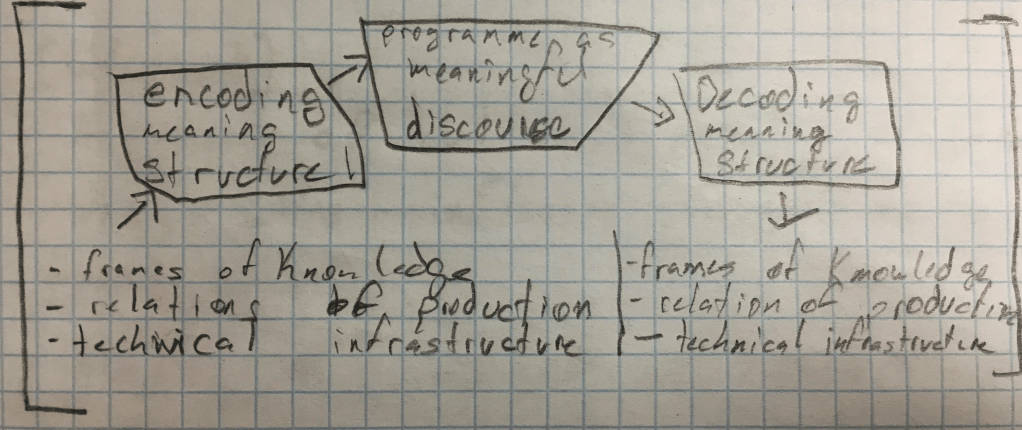
This can be boiled down into see, interpret, and understand. The way that we create things are based on what one knows, one feels, and with what one has and is the interpreted by the other by what they already know, feel and with the resources that they have to interpret the material. Imagine hearing free jazz in a bar. If the listener does not know anything about what the music is and does not have a desire to hear it, then it will just be mindless cacophony. The chances are that the person listening will not find any value in it! If there is noise in the understanding of what is being interpreted by the listener, then it will often times be looked down on. This is common in music because of how drastically different music can be and how varied the cultures around different music can be. I once played a show without knowing that the other bands were 4 metal bands. I played this show with eyeliner, Sharpie-d on nails, platform boots, and while I talked about how I did not eat meat or do drugs. Many of the people who were there decoded me as a body that did not belong. This meant that despite me being polite to others, that I was going to be seen as going against the “hegemonic dominant view” of masculinity in this given context. These people opted to not talk to me, have never since spoken to me. I cannot fully understand what they were thinking, but I can attempt to understand it as me being seen as a moderately oppositional person in this context. I was a tall person dressing in a slightly more feminine way in a room of people who were fans of a genre known for being hyper aggressive. This is because of association with the hegemonic ideas of the feminine and the concept of it not being able to be associated with aggression, resulted in me being completely avoided in this context.
But what creates these behaviors and joined traits of people who listen to a certain genre of music is just a taught or learned behavior or mannerism that has be shown through an experience they had. It’s essentially Dawkins of definition for a meme. To be quite honest, often times the real way that people get an idea of what to look like is from memes on the internet. It becomes a stereotype that is created, meme-d, interpreted, absorbed and re-created in one’s own self presentation. If memes are the inside jokes of a culture, then putting yourself in place where you understand and relate to those jokes is one of the fastest ways to be accepted by a community. This means that if metal fans are shown pictures of ridiculously greasy muscular men with long black hair who like Satanism and hyper violence, then chances are good that the self-acclaimed metal fan will start emulating that in a way. It was very similar for me growing up, where I was shown that men in bands looked a very certain way. If you wanted to play loud music with guitars and smooth vocals, then you had to look a certain way. If I wanted to be associated with the rock boy bands of the early 2000’s then I had to be thin, wear some very close-fitting jeans, have some fairly long hair, and live with the idea that older people were going to put me down because I was no longer trying to do as they wanted me to. I also started skate boarding, because I was a sheep. These can all be understood as signs to be understood through semiotics. These signs were also understood by many to mean other things. To more conservative members of the town I grew up in, it was an indicator of me not being straight (which turned out to be correct, but was almost always seen as a negative), that I was destined to be poor, a bad student, a drug user, a criminal, or ultimately just another stereotype. When it was seen by people at that metal show, it was assumed that I as a musician was not capable of providing what they wanted based on how I looked, and also that I was not worth their time to speak to because they knew I would not be like them. This meant that when I performed, some of the people left, and some barely cared or supported when it came time for them to be there (like they had been for the other musicians there). It quickly turned into my band playing to the 15 friends and family members that we had convinced to come. While not the worse experience, it was very obvious that the message being put out was not one that was going to be interpreted well.
In conclusion, encoding and decoding is an important tool to be used to understand social situations and in part sub cultures. Many times, people who exist within a sub culture will see other people based on a physical identifiers and signs of inclusion that they present. When thinking of music, the more the individual looks like the role that they are assigned with in the sub culture, the more easily a group or individual is accepted, and the higher their chances of inclusion become. I wish to look more into this to provide more to this conversation of being an artist in specific cultures and to understand how exactly one encodes themselves and whether or not that can become an empowering experience.

 Kai Kiernan